
It’s a story we hear too often in clinic: a woman walks into her doctor’s office, explains the brain fog, the restless sleep, the painful sex, the hot flashes that leave her drenched. She’s looking for answers, for options, for validation.
Instead, she’s told: “Your symptoms aren’t severe enough for treatment.”
She leaves confused. Frustrated. Sometimes even questioning herself. Was she overreacting? Did she make it sound worse than it is? Should she just wait until things get “bad enough”?
This is the reality when healthcare providers aren’t menopause informed.
The Myth of “Severe Enough”
The idea that women must prove their suffering to qualify for support is deeply flawed. Menopause is not a disease, but it has very real health consequences if ignored. The focus should not only be on crisis management when symptoms are unbearable. Prevention is also a valid, evidence-based reason for care.
Hormone therapy, for example, is not just about hot flashes. Research shows it:
Bone health – Estrogen protects against accelerated bone loss. Using hormone therapy can reduce the risk of osteoporosis and fractures.
Genitourinary health – Even without bothersome symptoms today, many women will experience vaginal dryness, urinary tract infections, or painful sex down the road. Early treatment prevents progression.
Quality of life – Sleep, mood, energy, and cognition all intersect with hormones. These are not “mild” inconveniences. They shape daily life and long-term health.
Prevention Is Enough
Not every woman will choose hormone therapy. And that’s okay – there are multiple paths to thrive in menopause. But every woman deserves access to informed discussion, accurate risk–benefit analysis, and the freedom to choose prevention as a valid indication for care.
You don’t have to wait until you’re broken to get support. You don’t need to justify why you want to protect your bones, your brain, your heart, or your vagina. Prevention is treatment.
A New Standard of Care
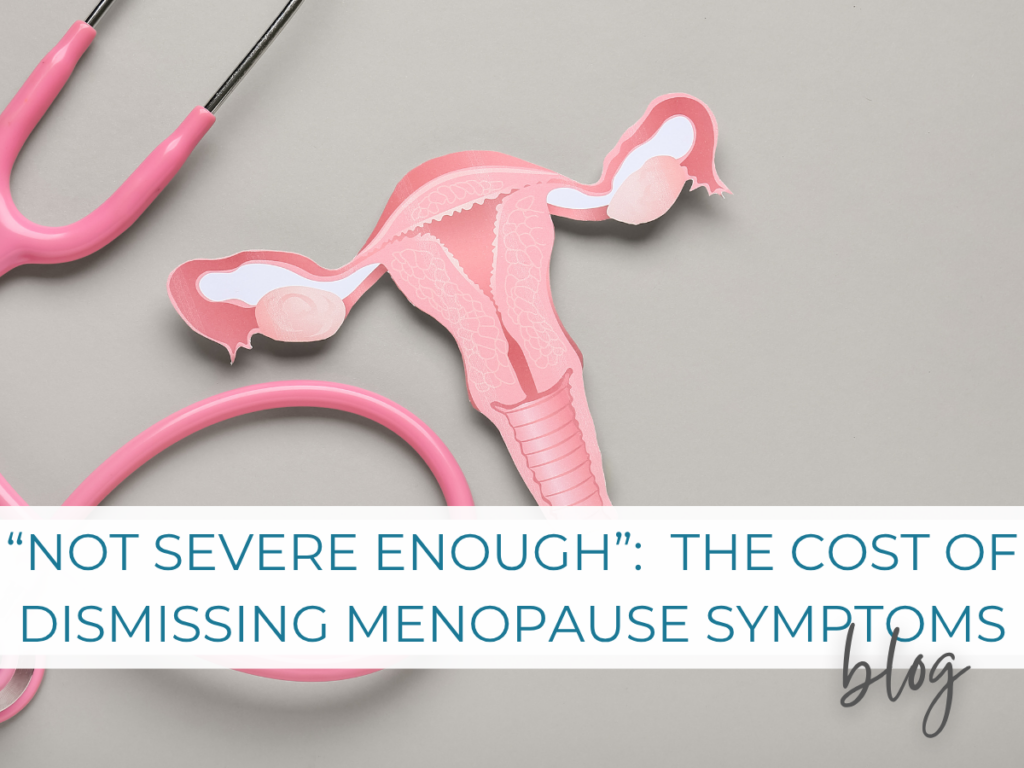
The question should never be, “Are your symptoms severe enough?” The better question is, “Are your symptoms affecting your life?” If the answer is yes, whether that’s through disrupted sleep, diminished energy, difficulty concentrating, painful sex, mood changes, or concerns about future health risks, then the conversation is worth having. Menopause care shouldn’t be reserved for crisis management. It should be available whenever women want to better understand and support their health.
The narrative that menopause management is only for “severe” cases leaves countless women underserved. It minimizes the impact of symptoms, delays care, and overlooks prevention — all while leaving women to navigate this transition alone.
What we need is a shift:
- From gatekeeping to guidance
- From symptom dismissal to proactive prevention
- From “prove you’re suffering” to “let’s support your long-term health”
Because thriving in menopause should not be about convincing someone else your symptoms are valid. It should be about having the knowledge, access, and choices to protect your health and quality of life for decades to come.
This article is for educational purposes only and is not a substitute for individualized medical advice, diagnosis, or treatment. Speak with a qualified healthcare professional about symptoms or health concerns.